Search This Blog

Showing posts with label periodic table. Show all posts

Friday, May 16, 2014

List of representative elements in the Periodic Table?

The following is a list of all elements in the periodic table that are representative elements.
Hydrogen, Helium, Lithium, Berillium, Boron, Carbon, Nitrogen, Oxygen, Florine, Neon, Sodium, Magnesium, Aluminium, Silicon, Phosphorus, Sulfur, Chlorine, Argon, Potassium, Calcium, Gallium, Germanium, Arsenic, Selenium, Bromine, Krypton, Rubidium, Strontium, Indium, Tin, Antimony, Tellurium, Iodine, Xenon, Cesium, Barium, Thallium, Lead, Bismuth, Polonuim, Astatine, Radon, Francium and Radon.

According to groups these are:

  • In group 1 (alkali metals): Hydrogen, Lithium, Sodium, Potassium, Rubidium, Cesium, Francium
  • In group 2 (alkaline earth metals): Berillium, Magnesium, Calcium, Strontium, Barium, Radium, 
  • In group 13 (boron family): Boron, Aluminum, Gallium, Indium, Thallium
  • In group 14 (carbon family): Carbon, Silicon, Germanium, Tin, Lead
  • In group 15 (nitrogen family): Nitrogen, Phosphorous, Arsenic, Antimony, Bismuth
  • In group 16 (oxygen family): Oxygen, Sulfur, Selenium, Tellurium, Polonium
  • In group 17 (halogens): Fluorine, Chlorine, Bromine, Iodine, Astatine
  • In group 18 (noble gases): Helium, Neon, Argon, Krypton, Xenon, Radon

According to rows these are:

  • Period 1: Hydrogen, Helium
  • Period 2: Lithium, Berillium, Boron, Carbon, Nitrogen, Oxygen, Florine, Neon
  • Period 3: Sodium, Magnesium, Aluminium, Silicon, Phosphorus, Sulfur, Chlorine, Argon
  • Period 4: Potassium, Calcium, Gallium, Germanium, Arsenic, Selenium, Bromine, Krypton
  • Period 5: Rubidium, Strontium, Indium, Tin, Antimony, Tellurium, Iodine, Xenon
  • Period 6: Cesium, Barium, Thallium, Lead, Bismuth, Polonuim, Astatine, Radon, Francium and Radon

What is the reason that atomic size varies among the elements of the periodic table?

The atomic size of an element depends two things:
  • Number of electron orbits around the nucleus
  • Nuclear charge
Each of these reasons are explained below.

Number of electron orbits around the nucleus

The electrons in an atom are arranged around the nucleus in different levels called shells or orbits. For example, in a sodium (Na - 11) atom, there are a total of 11 electrons that are arranged in three successive orbits around the nucleus shown by the following diagram:
Sodium atom with three orbits
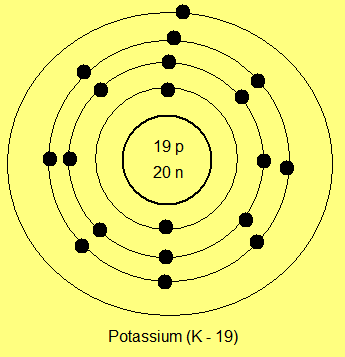
The more the number of orbits, the lager is the atomic size. For example, potassium, which has four electron orbits, one more than sodium, has a larger atomic size than sodium:
Potassium atom with four orbits
Thus we can conclude that the atomic size varies in the periodic table with the number of electron orbits. In the periodic table, the row number of an element is equal to the number of electron orbits present in its atom. Thus, as mentioned above, sodium, being in the third period, has three orbits while potassium, being in the fourth row, has four orbits.

Thus the atomic size of elements of elements increases as you move down in the groups (columns) of the periodic table.

Nuclear Charge

The atomic size of an element depends on the nuclear charge. Nuclear charge is the number of protons int the nucleus. The more the number of protons in the nucleus, more is the attractive pull on electrons around it. So out of two elements having the same number of electron orbits, the one with the greater nuclear charge has the lesser atomic size.

For example, magnesium (Mg - 12) and alumnium (Al - 13) both have the same number of orbits (since both are in the third row of the periodic table and hence both have three orbits in their atoms). But aluminium has greater atomic number (13) than magnesium (12) which means that there are more number of protons in an aluminum nucleus than in a magnesium nucleus. Thus the attractive pull between the nucleus and outer electrons in aluminum atoms is greater than in magnesium. As a result, the electron orbits in aluminum atoms move closer to the nucleus than in magnesium.

Thus two elements having the same number of orbits have different atomic sizes based on their respective nuclear charges; The one with greater nuclear charge has smaller atomic size than the one with lesser nuclear charge.

Sunday, November 11, 2012

What are alkali metals on the periodic table?

  • Alkali metals are all the elements present in the first group of the periodic table.
  • Alkali metals in order from top to bottom are Hydrogen (H), Lithium (Li), Sodium (Na), Potassium (K), Rubidium (Rb), Cesium (Cs) and Francium (Fr).

Chemical properties of alkali metals:

  • Alkali metals are electropositive in nature. This means that the atoms of these elements tend to lose their valence electrons and form positively charged ions.
  • Alkali metals donate one electron to form positive ions during chemical reactions or in their solutions
  • Alkali metals form ionic compounds with non metals
  • Alkali metals combine with halogens or group 7 non metals to form strong ionic salts. For example Lithium Fluoride (LiF), Sodium Chlordine (NaCl), Potassium Chloride(KCl), potassium iodide (KI), etc.
  • Alkali metals when dissolved in water react to form their respective metal alkalis and liberate hydrogen. For example when sodium metal is dissolved in water it forms sodium hydroxide, a powerful alkali: 2Na + 2H2O -> 2NaOH + H2

Physical properties of alkali metals:

  • Alkali metals have low melting and boiling points
  • Alkali metals are malleable, ductile and can be cut with the help of a knife
  • Alkali metals are lustrous, but their lustrous surface gets oxidized quickly on exposure to the atmosphere and so they appear as dull, white colored metals after a few seconds of cutting them.

Why do alkali metals include hydrogen, even though hydrogen is a nonmetal?

The elements are arranged in the periodic table in increasing order of their atomic numbers, and so atomic number forms the basis of arrangement of elements in the periodic table. Since atomic number of an element relates closely to its valency, electronegativity and chemical properties, the arrangement of elements in the periodic table is affected by their valency, elect negativity and chemical properties as well, although not based on it. Hydrogen although being a non metallic gas by physical nature, has a valency of +1, that is, it’s atoms have only one electron in their outermost shells, which it loses during chemical reactions to form positively charged ions. This is the case with all the alkali metals in the periodic table and no other element except the alkali metals including hydrogen show this characteristic in the periodic table. Due to this property hydrogen atoms behave like metal atoms in chemical reactions with other non metals, similar to the nature of alkali metals. Thus it is appropriate to place hydrogen in the alkali metals of the periodic table.
Placing hydrogen with helium would break the rule of having elements of similar chemical properties and valencies in one group of the periodic table.

Saturday, December 4, 2010

Who made the periodic table?

The periodic table was made by the effort of many scientists, chemists and physicists worldwide over a time period of many decades. It was made in order to arrange the elements in accordance with their chemical and physical properties.

It was Dmitri Mendeleev, in 1869, who made the periodic table we use today. His periodic table was the first one that was appropriate enough to be accepted as the official periodic table at that time. The arrangement of elements in it was such that it even allowed Mendeleev to predict the existence of yet undiscovered elements at that time, like putting the parts of a jigsaw puzzle together.

There was, however, a major anomaly in his periodic table, and that was the placement of isotopes. Isotopes are the atoms of the same element that have same atomic numbers but different atomic masses. Since Mendeleev's periodic table was arranged in increasing order of the atomic masses of elements, therefore the positioning of isotopes became a major issue in it. This defect was corrected in 1920 by Henry Moseley, who rearranged Mendeleev's periodic table by ordering the elements in increasing order of their atomic numbers rather than their atomic masses. Since isotopes have same atomic numbers, this periodic table did not have any fall-backs.

Thus, the current long form of the periodic table was established in 1920, but the credit of invention goes to Dmitri Mendeleev, since he was the one who made the basic structure of the current periodic table.

Other notable attempts to make the periodic table were of John Newland (in 1864/1865) and Doberiener (in 1829) in the Law of Octaves and the Law of Triads.

Friday, December 3, 2010

Why do we have a periodic table?

  Simply, the periodic table helps us to keep all known elements arranged in order. There are a hundred and eighteen elements discovered so far. Every element has a different set of chemical and physical properties. There are similarities in chemical and physical properties of many elements. There is a need to classify the elements properly so that we study all elements in an orderly fashion.

The periodic table contains elements arranged in increasing order of their atomic numbers. There are seven rows and eighteen columns in the periodic table. The rows are known as periods and the columns are known as groups. The periodic table is arranged such that there is a distinct variation of physical and chemical properties visible on it in the rows and columns. This makes it more useful as a source of classified information of elements.

The current periodic table was made by Dmitri Mendeleev in 1869. It was later on corrected by Henry Moseley in 1920. Before that there were many attempts made to classify the elements. Some of the notable attempts were the “Law of Octaves” by John Newland and “Law of Triads” by Doberiener. These all attempts were different methods used to classify elements. They aimed at arranging elements in a way that was most efficient and error free. However, each method had some errors that were not acceptable. So the attempts continued for decades until the modern periodic table was made by Dmitri Mendeleev and corrected by Henry Moseley.

The periodic table helps us to find the general properties of elements at a glance. It contains the atomic number, the atomic mass, and the symbol of elements. By looking at the position of an element in the periodic table, we are able to tell its physical and chemical characteristics to a high degree of accuracy. For example, all elements present in the first group will be metals, reactive elements, and will form ionic bonds with non metallic elements resulting in the formation of ionic compounds. They will be good conductors of electricity, and on dissolving them in water we will obtain their alkali and hydrogen gas.

Similarly, the elements of the seventeenth group of the periodic table will be nonmetals, reactive elements. They will form negative ions by gaining electrons, and they will react with metals to form ionic compounds.

Thus, we are able to guess the general chemical nature of an element from its position in the periodic table.

What does a periodic table have on it?

Elements. The periodic table has elements on it. Elements are arranged in the periodic table in rows and columns. The elements are arranged in the periodic table in the increasing order of their atomic numbers.

What are elements?

Elements are pure substances. They are made up of only one type of particles (atoms) throughout. There are 118 elements discovered till today. The elements make up all things in nature. They combine to form compounds, and all rocks, soils, air, water, are all made up of elements and compounds.

There are many different types of elements based on their physical states, chemical reactivity, and chemical properties. The most common classification of elements is metals, non metals, and metalloids (or semimetals). Metals are the elements like iron, gold, silver etc. Non metals are elements like oxygen, nitrogen, sulfur, carbon (like graphite and diamond), etc,

Since there are so many elements, so many types of elements, and so many chemical and physical properties of atoms of those elements, that it is essential for scientists, physicists, and chemists world over to be able to study, classify, organize and view all elements in a uniform way. Therefore elements are arranged in a table of elements, known as the periodic table of elements. Thus arises the need of a periodic table. A periodic table is used to arrange the elements so that they are in an orderly fashion and they are classified properly.

The periodic table is arranged in the increasing order of the atomic numbers of elements. It has seven rows and eighteen columns. Elements from left to right in each row have increasing atomic numbers by 1. At the end of each row, elements are arranged from left to right in the next row. In the first row of the periodic table, there are 2 elements, in the second and third row, there are 8 elements each; in the fourth and fifth row 18 elements each, and in the 6th and 7th rows, there are 32 elements each. The 7th row is considered to be an incomplete row, since newly discovered elements are added in it continuously.

There are two types of elements, one is the elements than occur naturally, and the other is the elements that are synthesized artificially. The artificially synthesized elements are not found in nature, but are made by people in the laboratory after a lot of work. These elements are generally the byproducts of radioactive elements.

Thursday, December 2, 2010

What is the periodic table?

The periodic table is an arrangement of elements in rows and columns. It is a table of elements.. At each intersection of a row and a column, one element is placed. There are a total of 118 different elements in the periodic table.

There are 7 rows and 18 vertical columns in the periodic table. The rows are called the periods in the periodic table and the columns are called the groups in the periodic table.

Elements are arranged in increasing order of their atomic numbers in the periodic table. This means that the first element has atomic number of 1 and the successive elements have atomic numbers 2, 3, 4, and so on.

The periodic table was made in order to arrange all known elements in a proper order, so that scientists worldwide can refer to it and not be confused by one anothers references. The periodic table was made in order to study the elements properties in an orderly way, and to avoid chaos in studying the properties of elements.

The periodic table helps us to remember all the elements. It classifies elements on the basis of their properties. For example, the metals are placed on the left and the middle of the periodic table, the non metals are placed on the extreme right of the periodic table, whereas the metalloids (semi-metals) are placed in the middle of the metals and the non metals in a zig-zag line in the periodic table.

So, to summarize it, the periodic table is a table of elements arranged in ascending order of their atomic numbers in rows and columns such that elements with the same chemical properties get huddled together in a group in the periodic table.
This is because the periodic table is arranged in the increasing order of the atomic number of elements, and the periodic law states that “The physical and chemical properties of elements are periodic functions of their atomic numbers”

Why periodic table is known as periodic table?

The word periodic means regular. It relates to the periodic table of elements in the following different ways:

The periodic table is known as the periodic table because it is based on the periodic law and because it is arranged so that the elements show periodicity of properties in it.

The horizontal rows in the periodic table are called the periods of the periodic table.

The periodic law says that "the physical and chemical properties of elements are the periodic functions of their atomic numbers." The modern periodic table is based on this law. That is why the periodic table is called periodic. In simple words, the periodic law means that when elements are arranged in ascending order of their atomic numbers, they show similarities in properties after regular intervals.

The phenomenon called periodicity of properties occurs in the modern periodic table. This is related to the above mentioned periodic law. In this phenomenon, the elements as arranged currently in the periodic table show similarities in their properties after regular intervals in the periodic table. These periodic properties also show a gradual variation in groups and rows of the periodic table. They are called the trends in the periodic table.

The periodic properties repeat themselves in the periodic table after regular intervals. These periodic properties are atomic size, ionization potential, electro-negativity, electron affinity, etc. These properties vary across rows and columns of the periodic table.

For example, the atomic size of elements decreases as we move from left to right across rows in the periodic table. This is because the number of shells remains same throughout each row of the periodic table whereas the atomic number increases. Due to this the attraction of the protons in the nucleus on the outer electrons of the atoms increases and therefore the outer shells come closer to the nucleus. Thus, the atomic size of elements atoms decreases as we move from left to right across a row of the periodic table.

Thus, the periodic table is called periodic because of the phenomenon of periodicity of properties in which certain properties of elements, called periodic properties, repeat themselves periodically throughout the periodic table.