Search This Blog

Showing posts with label atomic size. Show all posts

Friday, May 16, 2014

What is the reason that atomic size varies among the elements of the periodic table?

The atomic size of an element depends two things:
  • Number of electron orbits around the nucleus
  • Nuclear charge
Each of these reasons are explained below.

Number of electron orbits around the nucleus

The electrons in an atom are arranged around the nucleus in different levels called shells or orbits. For example, in a sodium (Na - 11) atom, there are a total of 11 electrons that are arranged in three successive orbits around the nucleus shown by the following diagram:
Sodium atom with three orbits
The more the number of orbits, the lager is the atomic size. For example, potassium, which has four electron orbits, one more than sodium, has a larger atomic size than sodium:
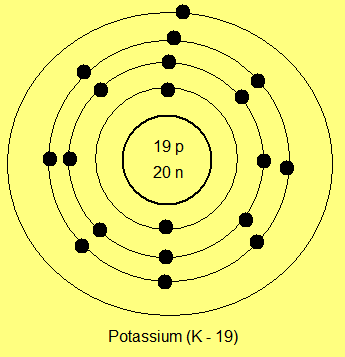
Potassium atom with four orbits
Thus we can conclude that the atomic size varies in the periodic table with the number of electron orbits. In the periodic table, the row number of an element is equal to the number of electron orbits present in its atom. Thus, as mentioned above, sodium, being in the third period, has three orbits while potassium, being in the fourth row, has four orbits.

Thus the atomic size of elements of elements increases as you move down in the groups (columns) of the periodic table.

Nuclear Charge

The atomic size of an element depends on the nuclear charge. Nuclear charge is the number of protons int the nucleus. The more the number of protons in the nucleus, more is the attractive pull on electrons around it. So out of two elements having the same number of electron orbits, the one with the greater nuclear charge has the lesser atomic size.

For example, magnesium (Mg - 12) and alumnium (Al - 13) both have the same number of orbits (since both are in the third row of the periodic table and hence both have three orbits in their atoms). But aluminium has greater atomic number (13) than magnesium (12) which means that there are more number of protons in an aluminum nucleus than in a magnesium nucleus. Thus the attractive pull between the nucleus and outer electrons in aluminum atoms is greater than in magnesium. As a result, the electron orbits in aluminum atoms move closer to the nucleus than in magnesium.

Thus two elements having the same number of orbits have different atomic sizes based on their respective nuclear charges; The one with greater nuclear charge has smaller atomic size than the one with lesser nuclear charge.

Saturday, December 4, 2010

How does atomic size of elements vary in the periodic table?

Atomic size definition:

This is the atomic radius. It is measured from the center of the atom to the outermost electron shell of the atom.

Factors on which atomic size is dependent:

The atomic size (or radius) of elements is dependent on the atomic number and the number of shells of the atoms of elements:
  • Atomic number: As the atomic number of elements increases, the atomic radius decreases. This is because the increase in atomic number means increase in the number of protons in the nucleus of the element. Increase in the number of protons means that the positive charge in the nucleus has also increased. The increase in the positive charge in the nucleus causes the outermost shell of electrons to be attracted towards it and thus the outermost shell is pulled towards the nucleus. This causes the decrease in the atomic radius of the atom.
  • Number of shells : As the number of shells of atoms increases, the atomic size increases since the distance between the outer most shell and the nucleus also increases.

Variation across rows and down groups:

  • On going from left to right in a row of the periodic table, the atomic radius of the elements decreases.
    Reason and explanation:
    The number of shells in the atoms of elements remains same, where as the atomic number increases one by one. Since the atomic number increases, the number of protons in the nucleus of that element also increases, and hence the attractive force between the outer electrons and the protons in the nucleus also increases. This causes a decreases in the atomic size of the elements, since the outermost shell is pulled closer to the nucleus by the increasing positive charge of the nucleus.
  • On going down a group of the periodic table, the atomic radius of elements increases
    Reason and explanation:
    On moving down a group of the periodic table, the number of shells in each elements atoms increases one by one with each element. This causes an increase in the atomic size of the elements as we go down a group in the periodic table. The atomic number of elements also increases as we move down a group, and that should reduce the size of the atoms, but the decrease in atomic size caused by the increase in atomic number is slight as compared to the increase caused by increasing number of shells. Therefore, the atomic size of elements decreases as we move down a group of the periodic table.